The City and the City
The City of London (not to be confused with Greater London, the city of 9 million residents within which it is nestled) is a baffling accident of history with which most people (and even many Londoners) are unfamiliar. Nicknamed "the Square Mile" for its size, it lies smack dab in the middle of Central London and makes up most of London's financial district. However, it is not considered a borough; rather, it is an independent city – the smallest in Britain – and has its own unique electoral system: being home to only 15 thousand residents and hundreds of corporate headquarters, it allows commercial firms to vote in the elections to the City of London Corporation, with voting power determined by the size of their workforce. As a result, business voters drastically outnumber the City's actual residents.
But how exactly did this arrangement come about? The City of London made up the entirety of "London proper" from its founding as a Roman fort around 47 CE until the establishment of the County of London under the Local Government Act of 1888; having failed to take it by force, William the Conqueror offered Londoners a compromise in 1067, granting them an extraordinary degree of autonomy in exchange for their loyalty. Due to the strength of its walls and the access to the seas via the Thames, London became the epicenter of trade and craft in medieval England.
Since the opening of the Royal Exchange in 1571, which served as London's first stock exchange, the City started attracting financial institutions from across Europe; by the end of the 20th century, it had headquartered the Bank of England, Lloyd's, and the present-day London Stock Exchange. From 1851 to 1991, the City's population declined from nearly 133 thousand to less than 4 thousand.
While it is widely seen as a "black box" designed to protect British and international capital from scrutiny, the City is still a London neighborhood with thousands of inhabitants. But where do they live? A decade after the Blitz, the local government tried to answer this question by commissioning the architecture firm Chamberlin, Powell and Bon, designers of the more social housing-oriented Golden Lane Estate, to come up with a development that would appeal to the employees of City-based corporations. What they delivered was an icon of modernist architecture.
Enter the Barbican
The residential portion of the Barbican Estate is made up of fourteen terraced apartment buildings, two blocks of mews (two-story houses modelled after stables), and four high-rise towers; all are named after British statesmen, artists, and thinkers (e.g. Thomas More, Oliver Cromwell, Daniel Defoe, etc). Cumulatively, they house approximately four thousand people. The terrace blocks encircle the complex's green space, complete with a wildlife garden and a number of fountains. Residents and visitors alike can also visit the truly impressive greenhouse; however, it is a very popular event venue, so one should check the opening dates in advance.
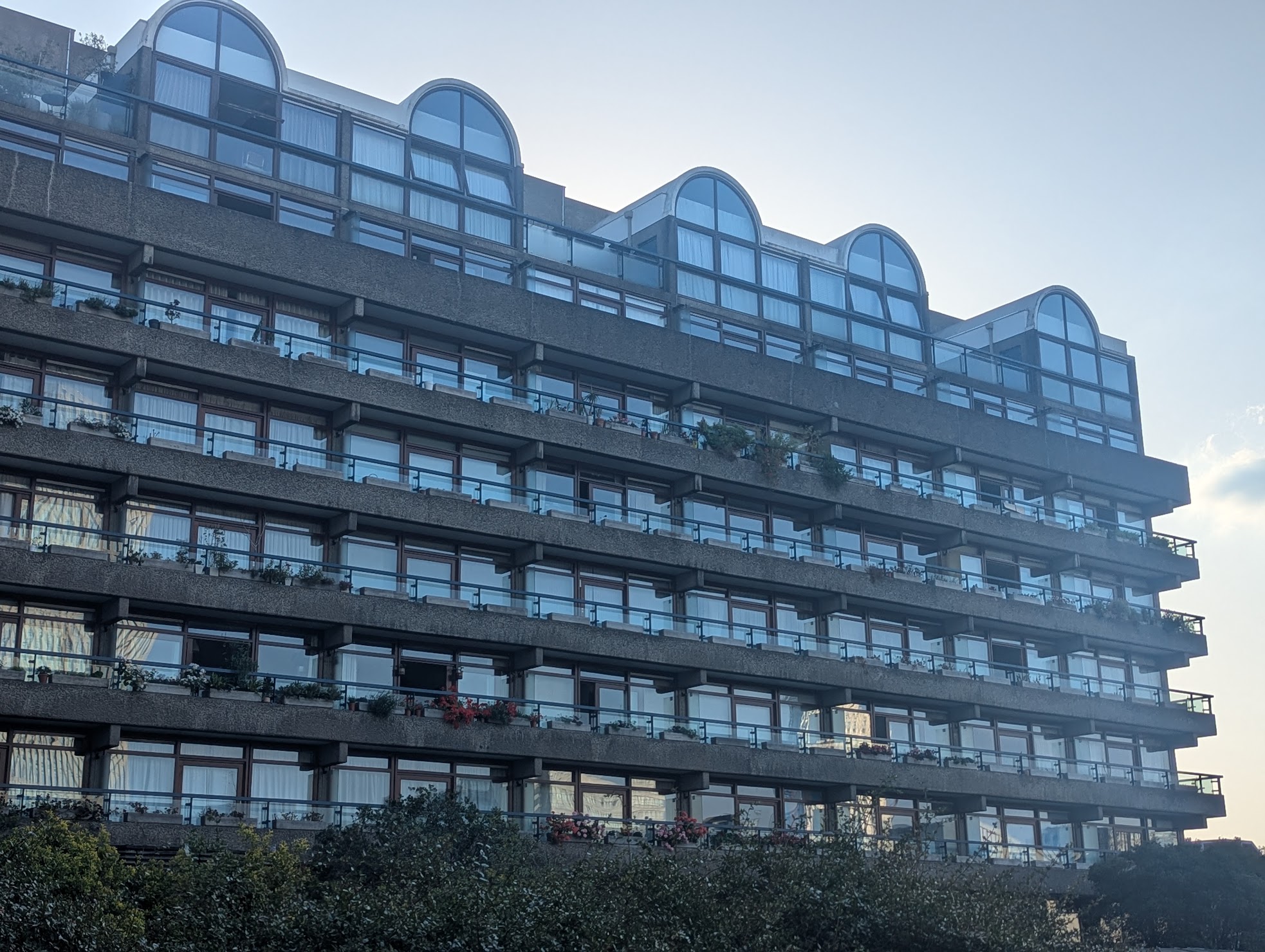
One of the estate's fourteen terrace blocks
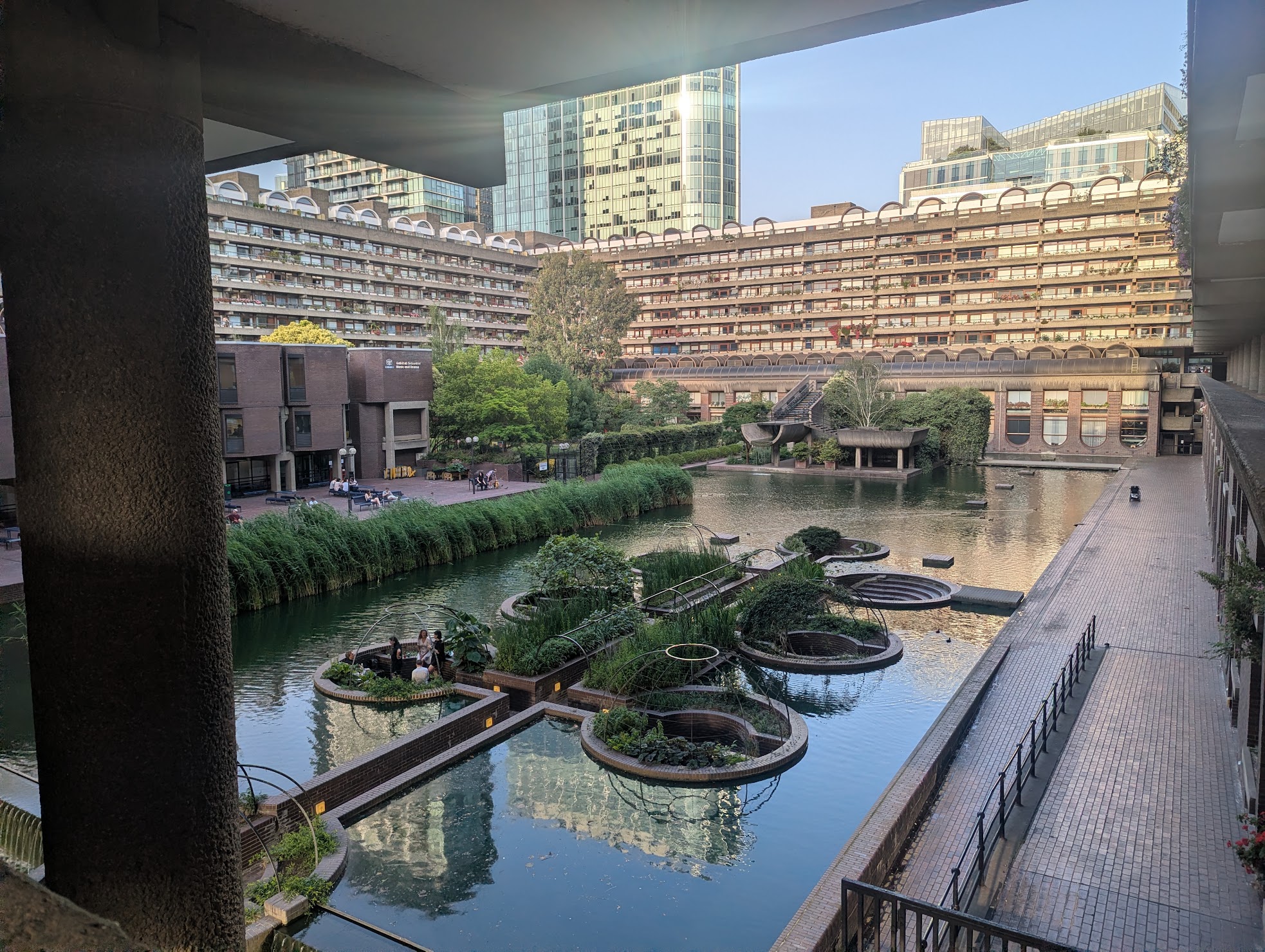
A view of the pond
The main non-residential component of the development is the Barbican Centre, an all-purpose cultural center featuring the Museum of London, a theater, a cinema, a library, an art gallery, and multiple restaurants. It is also home to the Guildhall School, Britain's premiere school of performing arts. Finally, the estate includes the historical St. Giles Church and the City of London School for Girls.
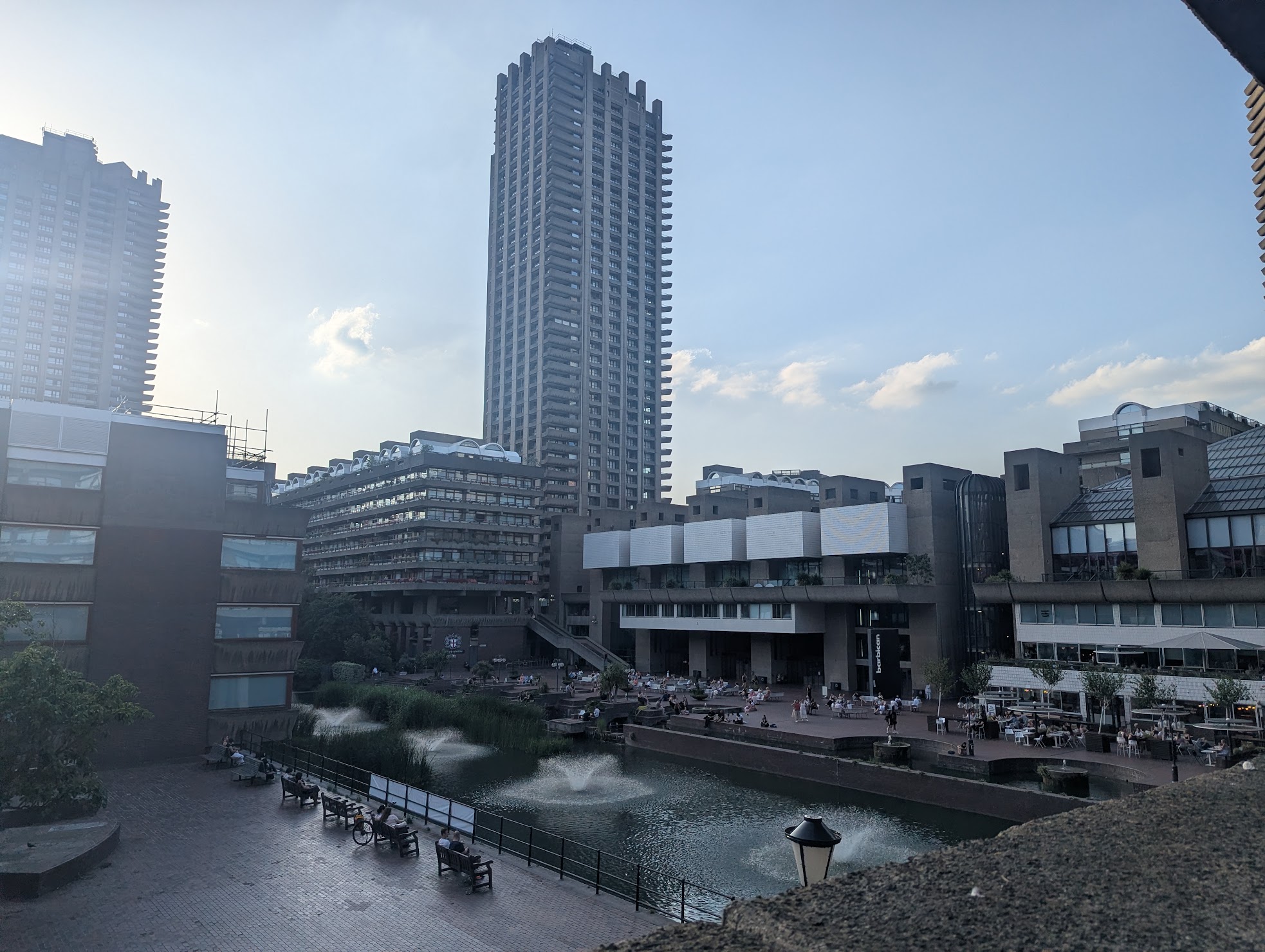
A view of Shakespeare Tower and the Barbican Centre
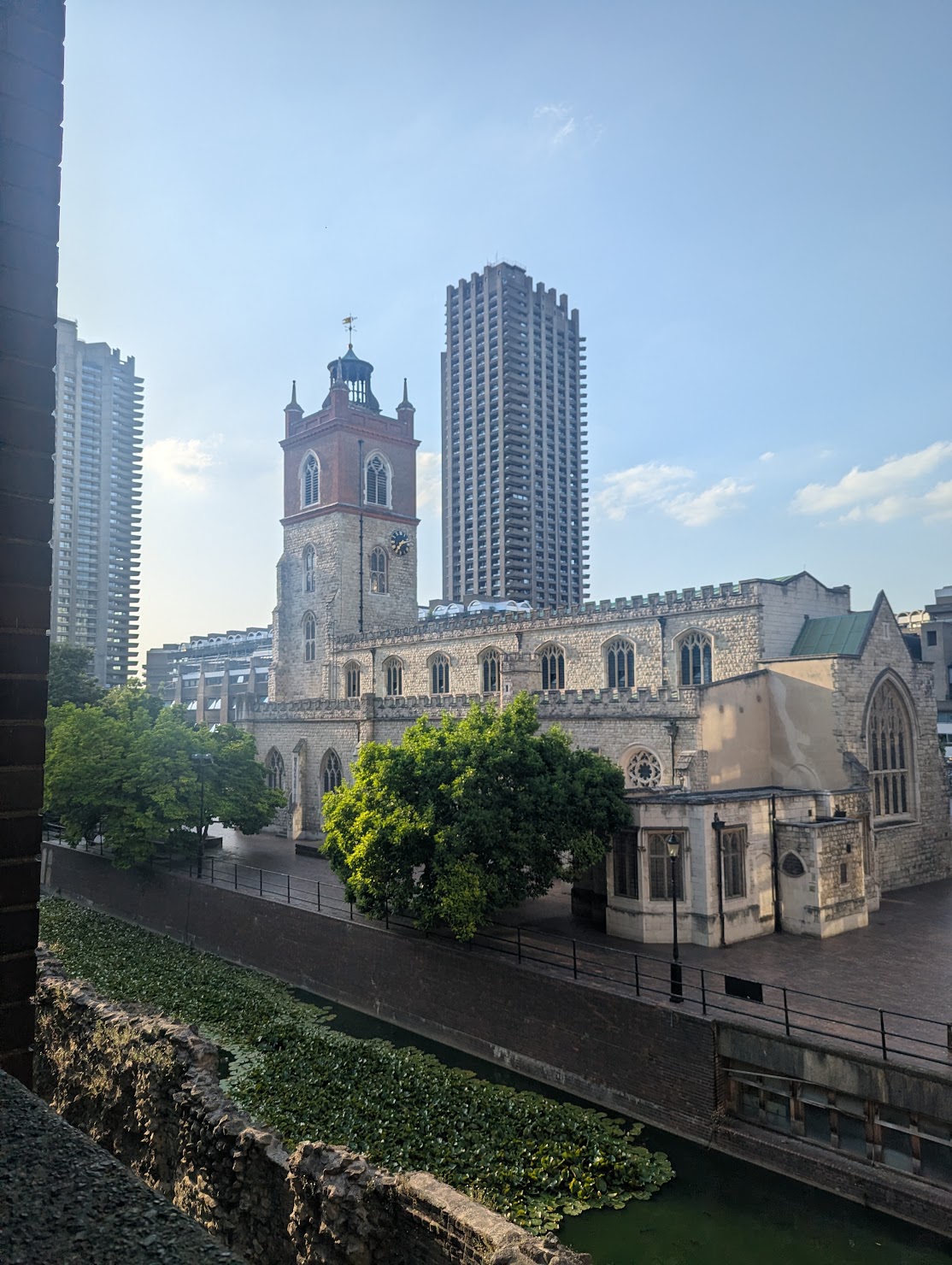
St. Giles Church
Even if you account for the Barbican's monumental size, the fact that a single real estate development built in a decade could fulfill such a broad variety of functions is almost mind-boggling. One cannot help but ask: why is the Barbican so unique? Thankfully, you wouldn't have to look far for an answer.
Coda
In the 34-year period between the end of WW2 and the ascent of Margaret Thatcher is considered to be the golden age of public housing in Britain. On average, nearly 92.5 thousand units of council-owned housing were built every year between 1945 and 1980. And while the Barbican was not intended to be an affordable development, the City of London Corporation was still the landlord. However, the Thatcher government mandated that local councils are obliged to sell the housing to its residents, in many cases far below market rate. To make matters worse, the proceeds from the sale of council homes could not be used to build new council homes. Combined with a ban on raising local tax rates above a certain threshold, this policy made it essentially impossible for another Barbican to be built.
Ironically enough, these policies were developed by two think tanks, the Centre for Policy Studies and the Institute for Economic Affairs, whose main benefactors are the very firms whose personnel and management reside within the Barbican. Though it does not seem like most of them are too perturbed by this knowledge. With a per-capita GDP of 10 million dollars, most of the City's inhabitants have little time for mere mortals.